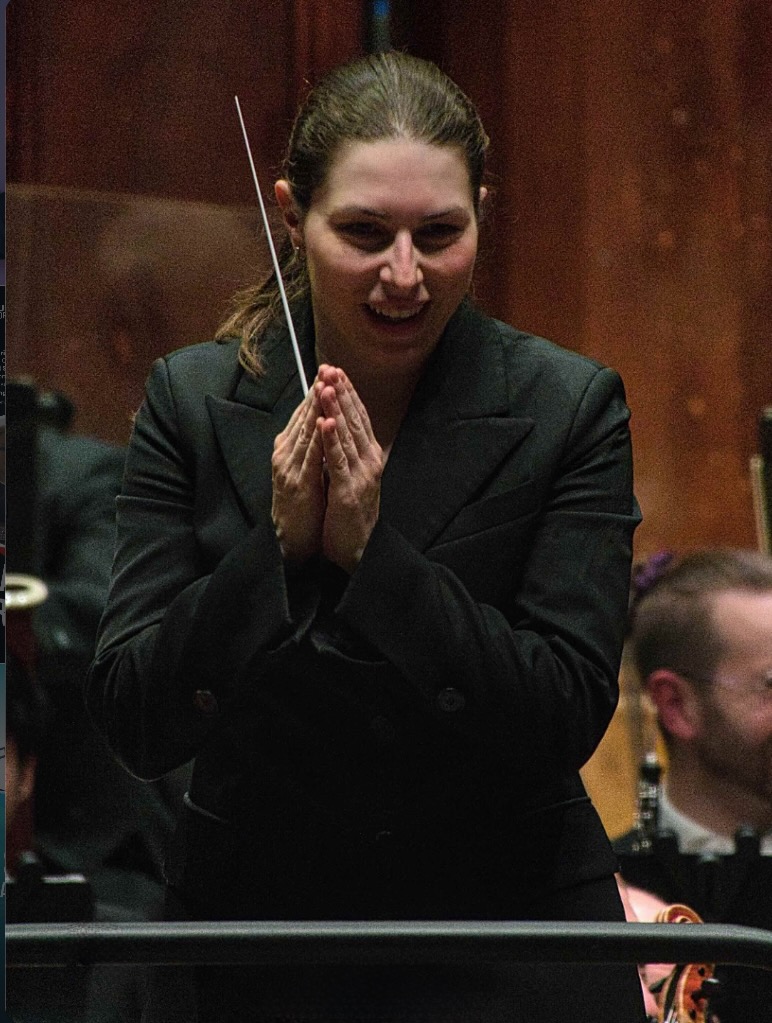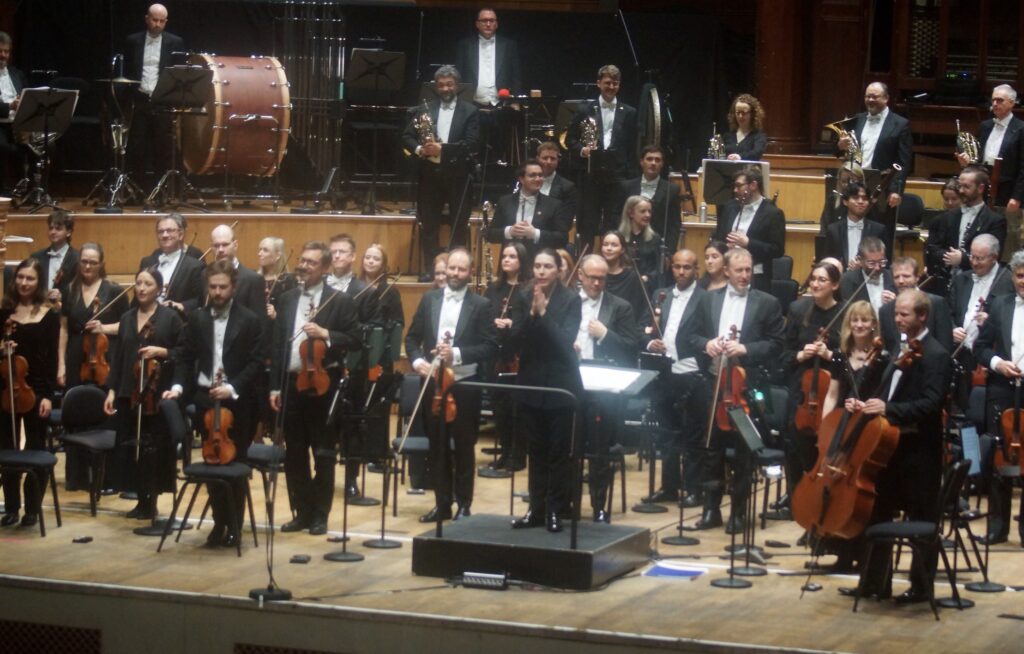
Every once in a great while, there’s a musician who grabs you the minute you see them onstage: someone who’s so self-possessed, so exciting, you can tell they just have it. For me, one of those rare people is the German-Colombian conductor Anna Handler, who I first saw at Tanglewood in 2025 during her first season as BSO assistant conductor. This season, Handler, 30, begins her tenure as Chief Conductor of the Ulster Orchestra and the LA Phil’s Conductor-in-Residence while continuing as Kapellmeisterin of the Deutsche Oper Berlin.
After seeing Handler lead Beethoven’s 7th on her final BSO concert at Tanglewood in August, I wrote:
“Handler has an obvious affinity for Beethoven’s music, conducting with fierce intensity and vivid focus. The musicians responded in kind, with sharp, crisp delivery and impressive extended solos…My most indelible memory of this performance was seeing – and hearing – Handler snap the page of her score just before launching into the final Allegro, which she took full-tilt, fast and furious. At one point, I caught a glimpse of Handler’s face, and she had a look of total rapture, almost as if she were being guided by some unseen force.”
On the heels of her concert with the Ulster Orchestra in Belfast two weeks ago, I had the chance to sit down with Handler – we had planned to meet up in person, but ended up doing it over Zoom – where we discussed her career trajectory as both conductor and pianist, her questioning of musical norms, and the importance of listening. Below are highlights.
Beginnings: The first conductor I ever saw was at the Bavarian State Opera, where I was singing in the children’s chorus of Hansel and Gretel. Later, when I was fifteen, my high school music teacher saw that I would take responsibility for different things in my class, and that I would accompany different people on the piano – including my sister Laura – all the time. So, he sent me to this masterclass conducting workshop which had an integrated competition, which I won. My teacher told me, ‘You should continue doing this because your hands…speak.’
On Entrepreneurship: I never thought I could rely on the system. There would always be another student who would be better liked by the teacher and then would get more attention, more time with the orchestra. So I said, ‘I’m not going to live in jealousy, or feel like I’m not being treated fairly. I’m not going to be a victim of these circumstances.’ So, I founded my own orchestra, Enigma Classica, and we did a lot of really innovative things, things with a social element that were really meaningful. It was absolutely one of the best things I’ve ever done in my life.
I look up to all of these people who founded their own groups – Teodor Currentzis, Philippe Herreweghe, René Jacobs – and how they work without union rules, 12 hour rehearsals, etc. Like a band. There was a time when I thought that was going to be my path. But, with your own orchestra, it’s so much about logistics, organizing people, getting people together for a project. You have less time to focus on the music.
The question is: if you want to change a system, how much do you have to be part of the system to change it? How much do you have to understand before you rebel against it?
On coming to America: Sometimes in life, you meet certain people and certain doors open. That’s what happened when I got into Juilliard and won the Kovner Fellowship after (former provost) Ara Guzelimian saw me and said, ‘That’s a real conductor. This is someone I want to mentor.’ After graduating, I won the Dudamel Fellowship with the LA Phil, which opened all sorts of doors.
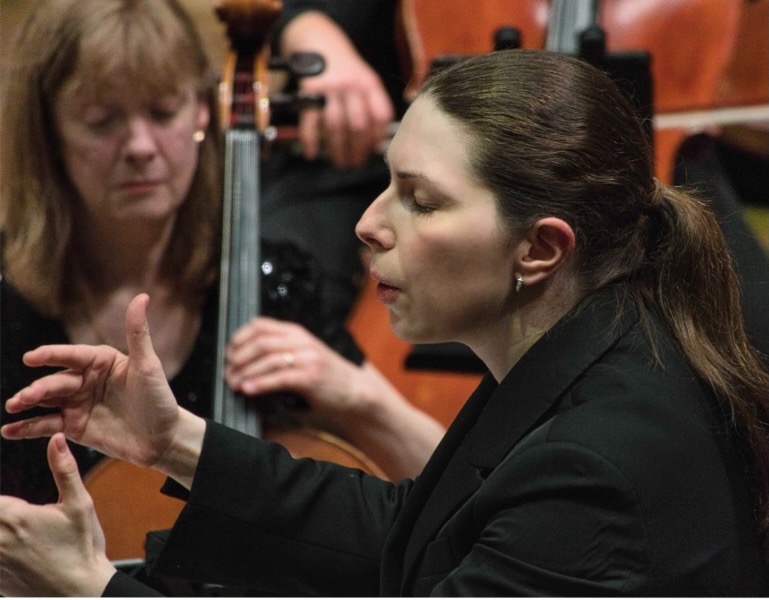
On being a Woman Conductor: I think of myself first and foremost as a human, and then second as a gender. But, I have been fortunate to have had several mentors along the way. In 2014, I had just graduated high school when I met (Ukrainian conductor) Oksana Lyniv, who had just become assistant conductor at the Bavarian State Opera under Kirill Petrenko. She was extremely generous with he knowledge and advice, and hired me to assist her on a series of projects. I remember her telling me, ‘You’re so talented, you know the score so well.’ Sometimes, the singers would be like, ‘Who is this young person?’ And she would tell me, ‘Don’t worry, you’re doing everything right. You just need to learn how to give feedback in a constructive way.’ I’m extremely grateful to Oksana.
Later, as a Dudamel fellow, I was an assistant to Mirga Gražinytė-Tyla when she was working at the NY Philharmonic. She was super honest and genuine: the way she dresses, the way she acts with her family. Everything was so natural. I look up to her. I used to have her picture up in my room!
On becoming a Chief Conductor: After Boston, it was my dream to have a smooth transition into my first chief conductor position. I wasn’t picky: I would have moved to Antarctica if they had an orchestra! Because the skills you learn as a Chief Conductor are so different than when you’re just a freelancer. You have a lot of responsibility, a lot more things to think about. I’m really grateful that I have the chance here to rise to the occasion. I think I’m a really ambitious person in terms of what I want to achieve. I take a lot of notes on what went well, what didn’t go so well.
On working with Musicians: When I was in Boston, you have these musicians who have played these pieces so many times. They have so much conviction, and offer something different every time. But then there’s this moment of meeting point, between their sound and my sound idea. I remember (principal flute) Lorna McGhee telling me after the Beethoven 7 that she wished she had caught the subito piano I was asking for during the performance.
At Ulster, everyone is so polite, everyone is like, ‘Whatever you want, whatever you need.’ There are so many young people in the orchestra, they’re so open to trying new things. But, I don’t want to be like, ‘It has to be this way.’ I want to have a conversation, especially with this music that I didn’t grow up with. But, as the leader, I have the responsibility for the outcome, so ultimately I need to trust my gut feeling. It’s all still very fresh: I look forward to when they can read me without me moving or saying anything.
When you talk from the podium, it’s all about how you make people fall in love with what you are in love with, this burning fire for something so strong that you are willing to go through any obstacle. I would follow Mulan into battle, you know?
On Being a Pianist: It takes a lot of work to keep it up. I’m supposed to be on holiday this week, but I’m going to Munich for a three-hour piano lesson before my recital in Bonn. (Handler is Artist-in-Residence this season at the Beethoven-Haus Bonn, where she is performing numerous recitals of Beethoven’s music.) It’s such a beautiful way to connect with his music. It’s different when you play them as a pianist than when you just conduct.
On the Art of Listening: I am extremely curious and content-driven. There is sound in music, but we have to give it meaning. I’m reading this book right now called Space Audiation by Edwin E. Gordon. ‘Music, performance, and audiation have parallel meanings. Music is the subject of communication. Performance is the vehicle for communication. Audiation is what is communicated. Although music is not a language, the process is the same for audiating and giving meaning to music as for thinking and giving meaning to speech.’
On Mission: I think as artists, we need to understand why we do art. Is it a tool to bring people together? Is it something we can’t live without? Or, is it just art for art’s sake? For me, I always feel that I have a social responsibility. Every gift that I’ve been given is here to serve society. Music is a tool.