
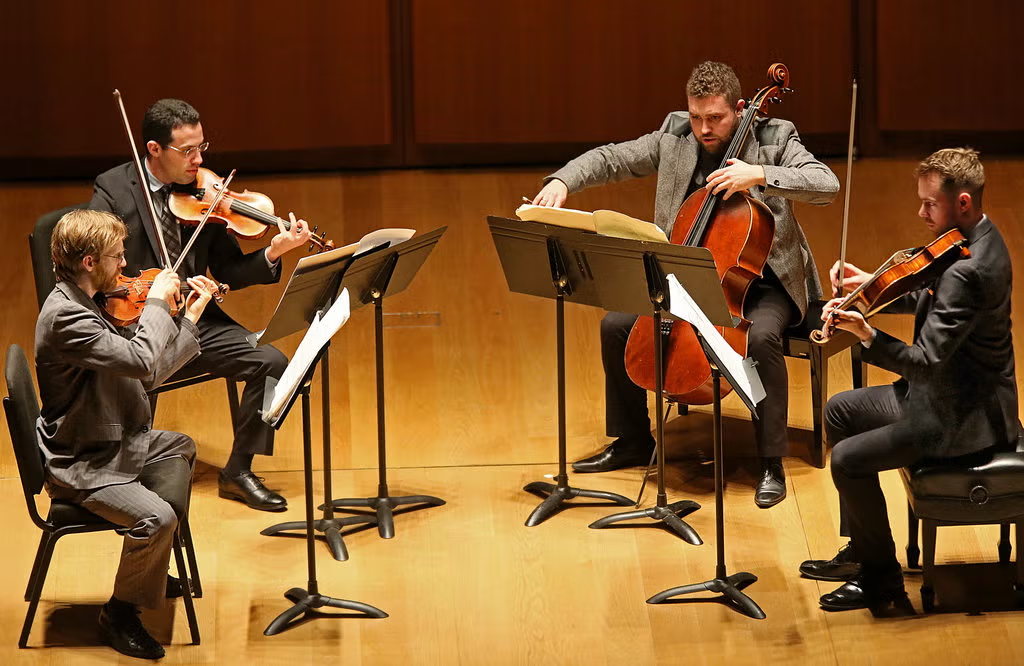
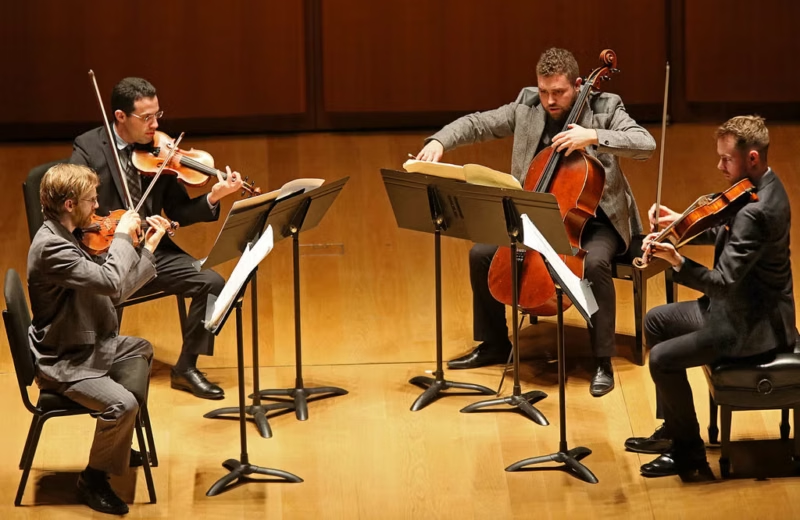
Photo credit: Ruby Washington, The New York Times
If you’re looking for a new musical concept to wrap your head around, look no further than German composer Helmut Lachenmann. Last Wednesday night at the Morgan Library & Museum, the JACK Quartet guided the audience on a journey—an intense lesson in musique concrète, a compositional style with which Lachenmann is closely associated.
Helmut Lachenmann’s three string quartets showcase a man with a seemingly unrelenting obsession with deconstructing and rebuilding the string-quartet form. Yet, as the masterful performance by the JACK Quartet demonstrated, deconstruction does not mean ignoring logic or dramatic form, nor does it mean a lack of emotional depth. Each listener hears this form and experiences the music differently, but the sounds are so intense and overwhelmingly articulate that it seems nearly impossible for one to not be moved by them. The music itself, which occassionally seemed to leave the edge of instrumental technique and fall into the abyss of some ethereal plane, displayed a compelling aesthetic in the expert hands of the quartet.
The group began with the most recently written and most “traditional” piece, String Quartet No.3, “Grido.” The players embraced the importance of the silences in the piece and let them linger before moving on to the next sumptuous texture. A single note or sound would receive extra treatment as if to point out that this particular moment was a pillar, a moment arrived at and soon to be left.
Gran Torso, written in 1979 and revised several time since, presented the most extreme intellectual and emotional listening experience; the harsh musique concrète ultimately fulfilling Lachenmann’s desire for a “greater democracy of sounds.” As the listener began to sink into the music, it became apparent that there was repetition and organization in the noise. The different timbres arranged themselves beyond their current predicament and existed as single sounds organized at a particular moment, never to be heard the same way again. The brutality and softness were given equal measure by the group, and the performance remained interesting and vital by never seeming to let one overtake the other.
The program closed with the whispered String Quartet No. 2, “Reigen siliger Geister.” Here, the spectral harmonics took a fairly standard technique and turned it into a barren landscape of sound. The bleak landscape crystalized each single sound as its own world. It was intriguing to see that, in a world full of Beethoven and Mahler, music can still be broken down and rebuilt with a multitude of fascinating atoms of sound.