
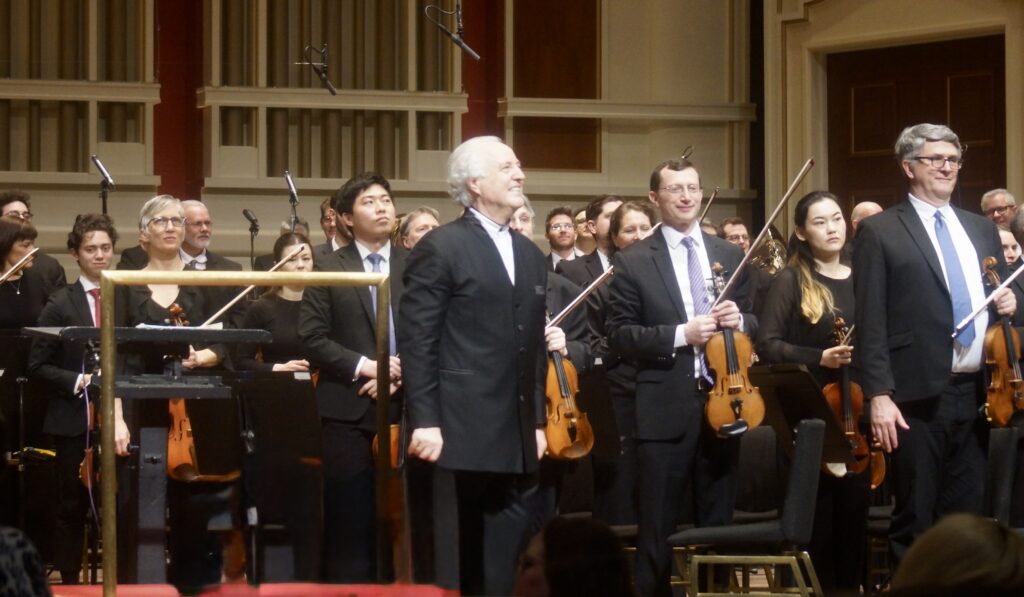
As I mentioned in my previous post, I’ve been attending concerts at Heinz Hall for nearly 30 years, a byproduct of some longstanding personal ties I have to the Steel City. While I managed to catch a few performances when Mariss Jansons was in charge, the bulk of the concerts I’ve seen have been led by Manfred Honeck, the PSO’s music director since 2008.
Over the past 18 seasons (he’s contracted until 2028) Honeck has managed to place his own distinct stamp on the PSO. He has hired some 47 players: nearly half of the orchestra, including concertmaster David McCarroll, who replaced Noah Bendix-Balgley when he left to become first concertmaster of the Berlin Philharmonic (also a Manfred hire). He’s implemented the seating position of basses back left, violins split left and right: the same arrangement used by the Vienna Philharmonic, where Manfred spent more than a decade as a violist. And he has made recording a priority, with some 16 releases to date – many of which have been nominated for Grammys – on Reference Recordings.
I first met the Austrian maestro exactly 20 years ago in Prague, where he was leading the Czech Philharmonic in a series of concerts celebrating Mozart’s 250th birthday. Now 67, Honeck has become one of the most in-demand conductors in the world, renowned both for his thoughtful, revelatory interpretations of familiar repertory and for his theatrical presentations of everything from Mozart’s Requiem, to instrumental suites he’s personally assembled from his favorite operas.
We met in Manfred’s suite at Heinz Hall a week ago Friday, where we discussed his time in Pittsburgh, his plans elsewhere, and how he decides when to take on a new work. Below are some highlights.
You performed at Carnegie Hall in December. What was it like to be back in New York for the first time in 11 years?
It’s always wonderful to perform in front of our home audience, but touring is something I’ve specifically asked to do. The Pittsburgh Symphony once regularly appeared in New York, and so to go back was a wonderful thing, especially with repertoire we like to play. (They performed works by Lera Auerbach, Rachmaninoff’s Paganini Rhapsody, and Shostakovich’s 5th symphony, with which they won a Grammy in 2018.) To have such a wonderful response made me very happy, because we work very hard to get the best result. I was excited to show the special sound of this orchestra.
Can you elaborate?
This orchestra is very sensitive. They are incredibly flexible and can produce a wide range of sounds, depending on what the music asks for. They can go for enormous power, but also enormous beauty. Whether light or dark, warm or cold, they know how to do it. They feel it. This is what I’ve worked on very hard here for the past 18 years. I know that all of the guest conductors who come here immediately want to come back because they are so amazed by the orchestra. It makes me very happy.

How would you compare your orchestra in Pittsburgh with some of the others you regularly guest conduct?
It all depends on what the concentration of the orchestra is. Some are more focused on contemporary music, others are concentrating on Viennese classical music. But, I must say, the overall level of the musicians in America is quite high. There are great orchestras here, and stylistically they are all quite different. Generally, they are all very eager to do whatever I ask for.
You’re known for your deep insights into these scores. Are you able to get these orchestras to follow you along with only a week’s rehearsal time?
As far as you can. It helps if they’re willing to perform the score as written, rather than fall back on widely adopted performance practices. For example, a score might call for a mezzoforte, but you only play forte. Or, you play piano, but it says “three p’s”. They are often surprised at how wonderful a famous symphony can sound if they only play what’s in the score. It makes it fun for them.
The first question I always ask when I open a score is: what is the will of the composer? What is he (or she) trying to say? Then, how can I convey this message from the composer to the orchestra. Whether you like what I’m doing or not, I am always aiming for a well-thought through interpretation: every rehearsal, every concert.
I played myself (with Vienna) under conductors who just let us play through, didn’t say anything, then we went home. The next day we played it through again, and that was it until the concert.
I bet it was still pretty good.
Ja. But you can still work a lot! With every orchestra you can work if you have a certain opinion about the music. I felt a little bit like, “We’ve played this Brahms symphony plenty of times. What is your inspiration to do it? Do something. Say something.”
How do you go about recording?
We record all three concerts. The morning after the first concert, I have a listening session and take note of all the things where I believe there need to be changes. Then, my assistant conductors write these down and at noon, they send it to the musicians. We do the same thing the next day. So, the musicians are constantly getting feedback, refining every detail. Sometimes, if the situation allows, I’ll even change things. Then after the last concert, we have a patch session.

Why do you feel recording is necessary when there are already so many recordings of these works?
I don’t want to make a recording just to have a recording. I want to convey a message with the recording, with the best quality possible. That’s why I’m not so keen on doing a Beethoven cycle or a Bruckner cycle. I want to record those pieces where I feel ready, where I feel I can add something, something different. For example, it took me a long time to do Beethoven 5, because I had to find something new to say, to do something special with it.
Do you ever get surprised during the recording process?
Of course! It’s always the composer, always the piece itself which takes precedence. For example, if I have an idea for a solo but the musician offers a better solution, I am most happy to change it. But it’s always most important to support the idea of the composer. How did they talk about their own piece? Today, in the Bruckner 8, you will hear a lot of things which are not written in the score. But, when you know the program, what he had in mind, then you know exactly what he’s trying to say. So, I take the freedom to change it.
What’s makes for an ideal performance?
We have fantastic concerts all of the time. But the goal should always be: Standout. To play with feeling. We all want to do the best, and the audience has the right to hear the best. After all, they paid for it!

I know you don’t get to do much opera here in Pittsburgh, but you do have several suites you’ve put together, like the Elektra Suite you performed with the NY Phil
Yes, I have seven of them now: Elektra, Turandot, Rusalka. I only select operas that don’t already exist in any concert form. I wanted to present this great music in a format where it can tell the story of the opera in the character of a tone poem. People are asking me all the time to do more of them – I think it’s great.
What’s on the horizon for you?
In August I’ll conduct six performances of Ariadne auf Naxos in Salzburg with Vienna. It will be my first time with them in 20 years: there were some attempts to do something before now, but I just couldn’t make it. After that, I’ll perform there with Pittsburgh, then on tour across Europe. (Note: with Honeck, the PSO regularly appears every other year at the Salzburg Festival, and is the only American orchestra performing there this year.)
Thank You, Manfred.
Nice to see you! It’s great that you could be here.
Honeck is in Pittsburgh for two more weeks of “Manfred Fest“, including concerts this week with Manny Ax – who’s heading to the ‘burg right after he finishes John Williams’ Piano Concerto with the NY Phil – followed by Mahler 2 (March 13-15), which will be recorded for future release. He then returns for a pair of all-American programs at the end of the season before heading home to Austria for the summer. Click through for tickets and info.
I like this weblog very much so much great info .