
“For me, (Ravel’s) music works the most when you do less.” – Jean-Efflam Bavouzet
2025 is the 150th anniversary of the birth of the brilliant, chronically underappreciated French composer Maurice Ravel, which has brought all sorts of celebratory concerts to shores near and far. While Ravel is perhaps best known for his orchestral showpieces – Bolèro, La Valse, Daphnis et Chloé, not to mention his orchestration of Mussorgsky’s Pictures at an Exhibition – I’ve always been drawn to his scaled-down music: the String Quartet, the Violin Sonata, the Piano Trio. They are models of elegance and efficiency: each note, each crescendo and metronome marking feels perfectly placed, like an expertly cut and polished jewel. (Ravel was a gifted yet fastidious composer, completing less than 100 works during his lifetime.)
Then there is Ravel’s solo piano music: a dozen or so works written between 1898 and 1917 that are simultaneously subtle and complex, hypnotic and stirring. I’ve loved this music for decades, as I’ve often had it on in the background while reading, writing or doing chores. Which usually turns out to be a bad idea, as the music inevitably worms its way into my subconscious like some kind of sonic tapeworm, distracting me from whatever else I’m doing.
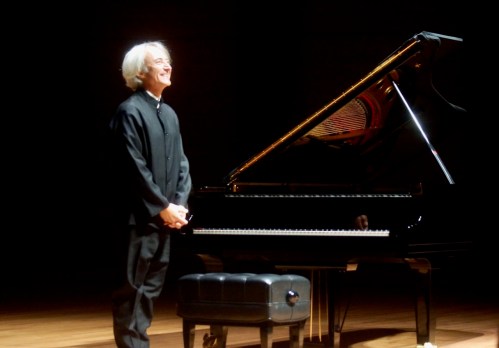
So, I felt like a kid in a candy store on Tuesday night when the French pianist Jean-Efflam Bavouzet came to Alice Tully Hall to perform Ravel’s complete piano solo music in a single concert, presented by the Chamber Music Society of Lincoln Center. Over his long career, Bavouzet, 63, has recorded Ravel’s complete piano music twice, including this year’s acclaimed Chandos release, joining a long line of Ravel sets including those by Abbey Simon (Vox), Jean-Yves Thibaudet (Decca) and Seong-Jin Cho (DG), who performed his own single concert Ravel cycle at Carnegie Hall back in February.

Settling in for an extended evening, I noticed right away that the piano onstage wasn’t the usual Steinway Concert D – which seems to have a near-monopoly on today’s concert stages – but a Yamaha CFX Concert Grand. This was no accident: Bavouzet played a Yamaha on his recent recording, choosing it for its clarity and transparency, with less resonance than the Steinway. (Bavouzet’s earlier Ravel set, from 2003, was recorded on a vintage 1901 Steinway, an instrument Ravel himself might have played.) “I wanted to have another sound for this music,” Bavouzet said recently, “something more modern, more crystalline.”
You’d think that one advantage of hearing all of this music in one go would be to gain some insight into Ravel’s musical development. But, remarkably, Ravel seems fully developed almost right out of the box: from the gentle flow of the Pavane for a Dead Princess – written when he was 24 – to the pristine, pointilistic beauty of Jeux d’eau (“Water games”) written two years later, this was music that had no obvious precedent. (Debussy, to whom Ravel is often linked, wrote most of his piano music after Jeux d’eau.) Bavouzet – who played the entire concert from memory – was a model of efficiency and restraint, letting Ravel’s music ebb and flow without any showy bravado.
Ravel’s piano music is at its evocative best when used pictorially. The five part suite Miroirs (1904-05) is perhaps most famous for it’s Spanish-flavored Alborada del gracioso (which Ravel later orchestrated), but no less remarkable is Une barque sur l’océan (“A Boat on the Ocean”) with its flurry of notes mimicking the rise and fall of a ship, or the haunting La vallée des cloches (“The Valley of Bells”) with its hypnotically tolling bell.
The three part Gaspard de la nuit is a tour de force for any pianist, full of virtuosic passages that frequently lean closer to Lisztian ecstasy than Ravel’s own tranquility. But even here there is quiet: after the opening “Ondine” with its torrent of arpeggios cascading like a waterfall, the haunting Le gibet (“The Gallows”) recalls the tolling bell from La vallée, the steady beat dark and ominous. The suite ends with the infamous “Scarbo”, its wild, demonic theme long a favorite showpiece for virtuosos, most of whom perform it out of context.
At some point in between Valses nobles et sentimentales and Ravel’s musical tributes to Haydn, Chabrier and Borodin, I realized that I’d lost all track of time: even as the concert crossed over into its third hour, I didn’t feel in the least bit fatigued, completely absorbed by Ravel’s endless invention and Bavouzet’s transporting playing. That carried over to the final piece on the program, Le tombeau de Couperin, Ravel’s musical tribute to the Baroque composer that somehow manages to look both backwards and forward, inserting striking dissonances within minuets and fugues. The closing Toccata races to the finish amidst a torrent of notes: when Bavouzet leaped from his bench at the end, he was met with a wild ovation.
And, since you can never have too much of a good thing, Bavouzet returned with an encore: Ravel’s solo piano transcription of La Valse, a fiendishly difficult work that is far more often performed in a version for two pianos. Despite this now being the fourth hour of the concert, Bavouzet dispatched it with incredible flourish, as if he was just getting started. What more could you ask for? Ne rien.

More pics on Instagram.