
“Life will be different for (Dudamel) now. New York is the center of the world, so everything you say is judged and very visible.” – Deborah Borda, NY Phil President Emerita (via NY Times)
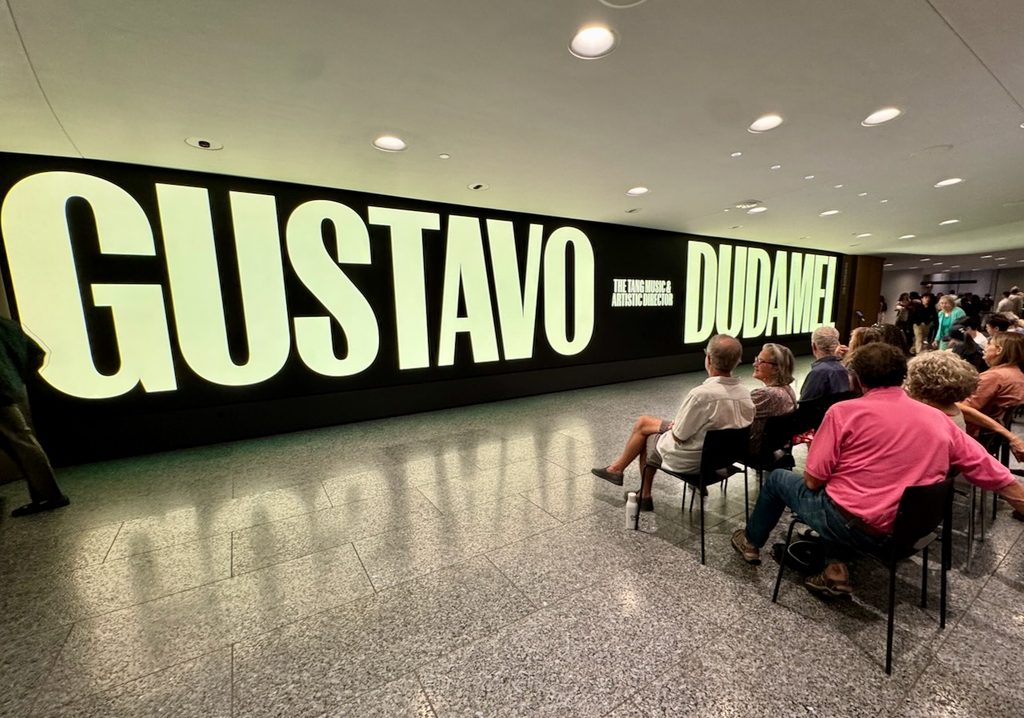
After three years, multiple “music director-designate” concerts and a magenta-colored marketing blitz, Gustavo Dudamel has, at long last, assumed his post as the 27th music director of the New York Philharmonic. With all of the billboards on our streets and screens heralding his arrival, you might think that Jesús Christo now walks among us.
For those of us who’ve been attending NY Phil concerts for decades, it’s been hard not to eye-roll. For one thing, Dudamel has already been a visible presence in New York since he was named music director in 2023, appearing at NY Phil season announcements, community events, and more than 50 concerts including galas, parks concerts and a World Cup halftime show seen worldwide. Not to mention he’s been guest conducting the Phil for nearly 20 years, beginning as a 26 year old in 2007. (I was there.)
It’s also worth noting that Dudamel will only spend about one-quarter of the year in New York, less if you count the three weeks he’ll be in Europe on tour with the Phil later this month. (As I’ve written previously, this is fairly typical among modern American music directors.) Dudamel’s primary residence will remain in Madrid, where he lives with his wife, the Spanish actress María Valverde, his 12-year-old son, and his parents. For all of the hype about Dudamel being the next Bernstein, I haven’t heard of any plans for him to conduct any televised concerts, or otherwise establish himself as a regular presence in city the way Lenny did during his time as music director.
More to the point, can any one person really make that much of a difference with this notoriously willful group, some of whom have been around since the days of Zubin Mehta? Despite the exhaustive efforts of orchestra marketing departments, who love to promote music directors as if they’re the only ones onstage, I’ve never been a big believer in the “conductor myth,” the notion that a conductor – particularly a chief conductor – possesses some kind of magical power over an orchestra by virtue of his – or her – artistic vision and personal charisma.
As I wrote following Dudamel’s debut in 2007:
“Standing on a podium and waving your arms around is not, by itself, difficult. Noone in the audience is going to know if you forget where you are in the score, or if you deliver a confusing gesture. Your balls aren’t on the line the same as if you’re a brass or wind player coming in on a solo, where one squeak or squawk can lay ruin to an entire performance. Most of the real work is done during rehearsal, where the conductor does his or her best to convey their vision of the piece to a bunch of scruffy musicians who are at best suspicious – and often mutinous – towards anyone with new ideas.”
At the time, several Philharmonic players expressed reservations about Dudamel’s inexperience while others praised his energy and musicality, with some generously comparing him to a young Leonard Bernstein. Others cited his capacity for listening and ability to get the orchestra to respond to his direction.
“He knows what he wants,” said then-concertmaster Glenn Dicterow, “and is not afraid to ask for it.”
Nineteen years later, Dudamel is now 45, and that persuasive power has been joined by a deep, wide experience acquired in front of the greatest orchestras in the world: Berlin, Vienna – but most of all the LA Phil, where he spent 17 years as music and artistic director, cementing his reputation as one of today’s most incisive conductors.
One bit of good news for New York is that the Phil is currently Dudamel’s only position, after he abruptly resigned from the top job at the Paris Opera two years ago. (In an interview with Le Monde, Dudamel cited “the desire to do fewer things, but more intensely.”) Aside from his continuing relationship with L.A., where he’ll spend 3 weeks this season, Dudamel has relatively few commitments this year.
At his first rehearsals here last month, Dudamel reportedly coaxed the players along in both English and German, as well as a smattering of his native Español. He managed to be both friendly and firm in his determination to achieve the sound he sought.
“To be honest,” he reportedly said at one point, smiling, “we are beautiful, but we are not together.”
“When he’s rehearsing, he addresses the orchestra as `My dears,’” recalled principal oboist Sherry Sylar, who’s been with the Phil since 1984. “Nobody has ever done that before. It just sort of changes the way you accept the criticism or suggestions.”
Beyond his famously kinetic podium presence, Dudamel’s has so mastered the core repertoire that he almost always conducts from memory, a rare distinction among maestros of his generation. At the same time, Dudamel has become a conspicuous champion of contemporary music, commissioning and conducting more than 60 new pieces during his time in L.A., including major works from Gabriela Ortiz, Andrew Norman and Thomas Adès, among many others.
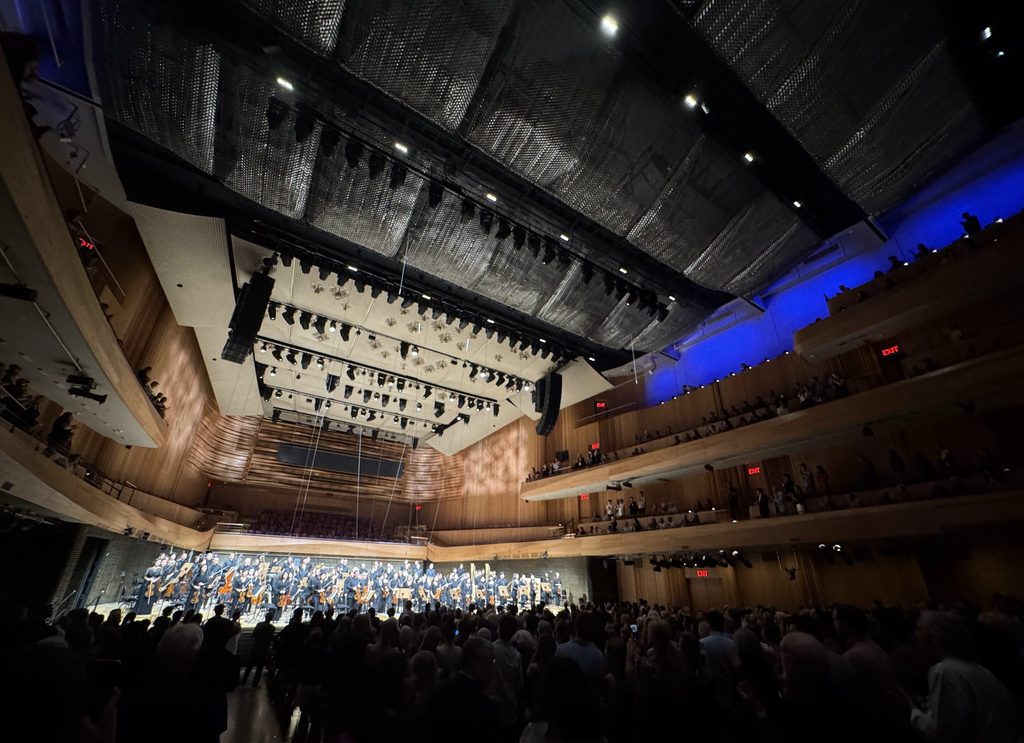
Both sides of Dudamel’s musical profile were on display during his first subscription concerts, which took place at David Geffen Hall over the past three weeks. (I wasn’t in town for his opening concerts, which included a cross-genre Radio City Music Hall extravaganza, followed by a somber 9/11 memorial at the Perelman Performing Arts Center.)
I was taken aback by the work Dudamel chose to open his first program as NY Phil music director: John Adams‘ “On the Transmigration of Souls,” which was commissioned by the Philharmonic in 2002 to commemorate the victims of 9/11, winning Adams his only Pulitzer Prize to date. (At the time, Adams accepted the award with decidedly mixed feelings.) For unexplained reasons, the Phil hasn’t performed it since, but Dudamel – who established a close relationship with Adams during his time in L.A. – clearly felt the occasion called for a revival, even if it contrasted with the otherwise-celebratory mood.
Written for orchestra, adult and youth choruses, the most memorable aspect of “On the Transmigration…” are the taped elements: city sounds that give way to disembodied voices reading from the “missing person” posters that once lined Union Square and subway stations.
For the most part quiet and atmospheric, the music rises 2/3 of the way through into one of Adams’ hallmark crescendoes, with low brass penetrating the oscillating strings and piercing chimes. The music then transitions to an eerie, atonal blend of celesta, quarter-tone piano and percussion over a voice repeating the phrase, “I see water and buildings…”, a quote from American Airlines attendant Amy Sweeny just before Flight AA 11 crashed into the North Tower of the World Trade Center. Dudamel dramatically held the final silence for what felt like a full minute before finally dropping his arms.
The Philharmonic was joined in the balcony above the stage by the New York Philharmonic Chorus and Brooklyn Youth Chorus, the latter of whom also performed on the premiere a generation ago. (Several singers from the premiere returned to mentor the BYC for these performances.) Both sang with remarkable clarity and precision, with the BYC singing their part from memory.
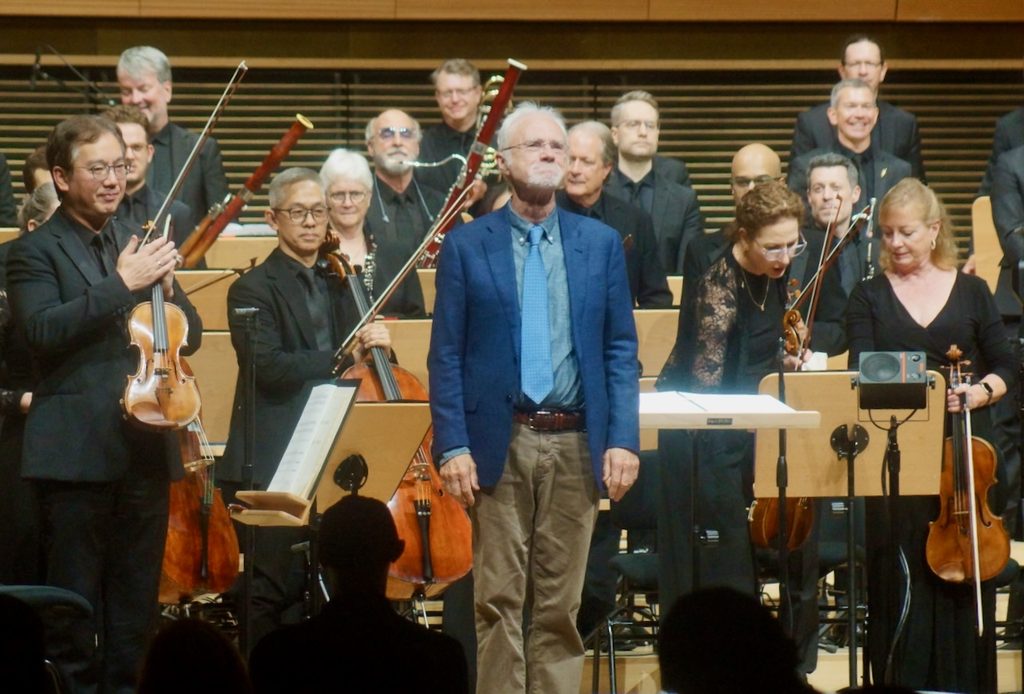
Adams was present in the hall to take his curtain call, during which the emotion of the moment seemed to catch him off-guard. 24 years on, Adams’ musical collage has lost none of its haunting power, especially for those of us who were here during that strange, awful time.
I was less moved by the world premiere of Zosha Di Castri’s Invisible House, co-commissioned by the NY and LA Phil. A Canadian of Ukrainian background who now teaches at Columbia, Di Castri says that her work was inspired by the poetry of Ilya Kaminsky and Ukrainian folk songs. (According to the liner notes, the piece’s title refers to both the bombed homes of Ukraine and the spiritually vacant homes of America, where Kaminsky now lives.) To me, it just sounded chaotic and overly bombastic, without any discernible structure. The piece grew quieter and more contemplative over the final five minutes, eventually fading into an obscure silence. Di Castri was also on hand to receive a warm ovation.
The concert ended with Prokofiev’s propulsive 5th symphony: a full-circle moment for Dudamel, who also conducted the symphony in on his NY Phil debut in 2007. Then as now, Dudamel conducted from memory, allowing him to hold the full attention of the musicians, who seemed to play with more focus and energy than usual, using the traditional German seating of violins split left and right, double basses back left.
In the Andante, principal clarinet Anthony McGill played his extended solo with the same brilliance he displayed recently at the BBC Proms, where he debuted Gabriel Kahane’s new clarinet concerto. Dudamel let it rip in the voluble finale, with strings, brass and percussion firing on all cylinders.
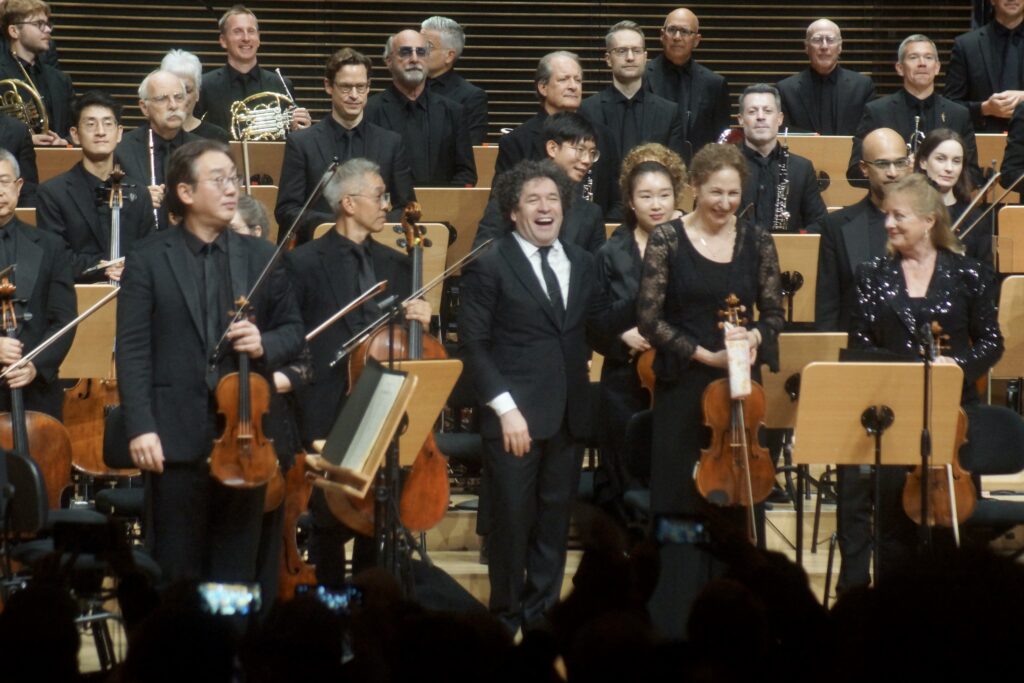
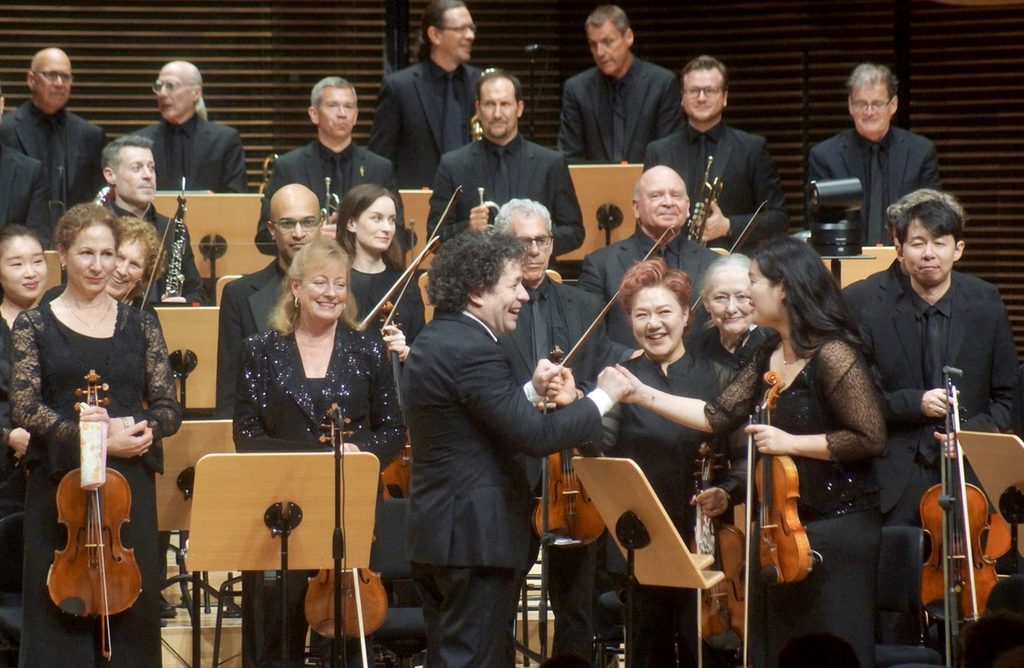
During the rapturous ovation that followed, Dudamel and the Philharmonic players shared an easy rapport, laughing and smiling together. The way you can only when you’re secure in what it is you’re doing, and where you’re headed next. (See: Vienna.) In a word: they looked like they were having fun.
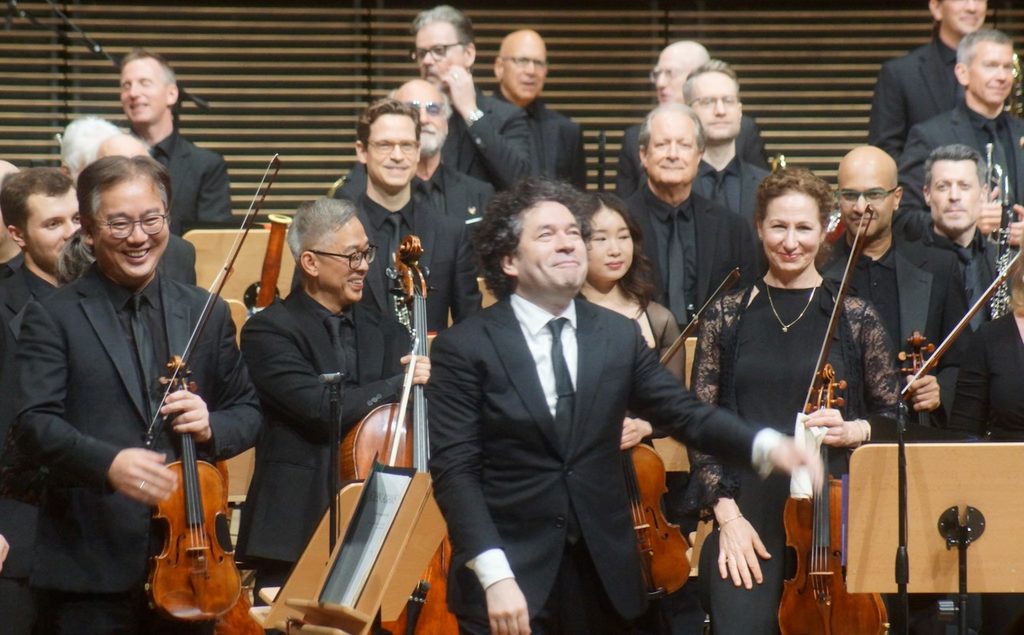
I was back in Geffen Hall on Tuesday for the fifth and final concert of Dudamel’s second subscription program. Five concerts? In the past, I might have worried about the Phil dialing it in after so many performances of the same program.
Not with Dudamel. No matter how many times he’s performed a particular work, Dudamel seems completely committed, always finding new things to focus on, new ways to express his enthusiasm. And, as if by osmosis, the Phil seems just as invested, joyfully so.
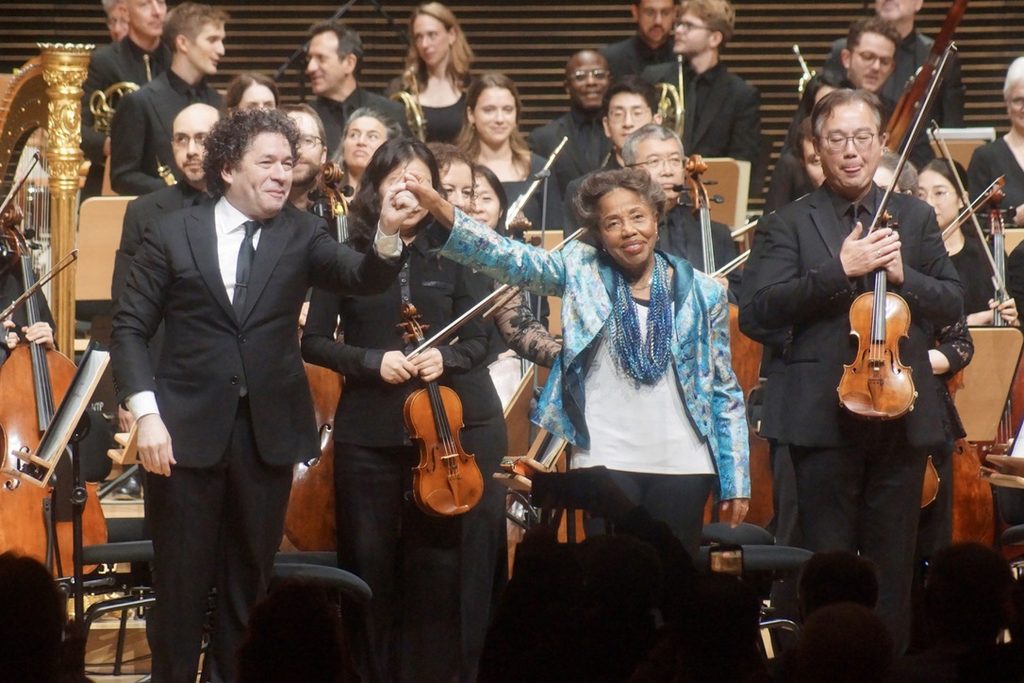
It helps when you’re leaning into a new work, as they were with Tania León’s “Imágenes Mestizas,” which opened the program. León, a longtime New Yorker whose Pulitzer Prize-winning “Stride” was commissioned by the Phil in 2020, says the work is a reflection of her own multicultural background and the different genres that have been a part of her musical evolution: classical, jazz, Latin and African music. To me, it mostly came across as a jumble of disconnected sounds, primarily exotic percussion instruments such as the shekere, chapachas (goat hoof rattles) djembe and doumbek. Interesting, but not particularly coherent. No matter, the hall erupted in cheers when Dudamel brought the 83 year old León onstage to take a bow.
It’s no surprise the Dudamel chose to play to his strengths in his first concerts as music director, and nowhere is he more confident than when conducting the symphonies of Gustav Mahler, whom he can now refer to as his predecessor. (There is a portrait of Mahler on the wall of Dudamel’s maestro suite in Geffen Hall, alongside Bernstein, Toscanini and Willem Mengelberg.)
Dudamel has already led two acclaimed performances of Mahler symphonies with the Phil: the 9th in 2023 and the 7th last season. To close out this two-week run, he conducted what might be his best Mahler of all: the 5th. Simply put, this was a performance of epic proportions, extraordinary in every way. Crackling with energy, Dudamel kept an efficient tempo throughout without wallowing in fake drama as so many conductors do, particularly in the famous “Adagietto.” Dudamel kept the concluding Rondo-Finale in check until the final moments, when the orchestra let out the loudest Roar I’ve ever heard in Geffen Hall.
As much as Dudamel deserves credit for his remarkable interpretation and attention to detail, it wouldn’t mean much if he didn’t have the right the players to deliver the goods. Alongside familiar Philharmonic faces such as principal trumpet Christopher Smith and principal trombone Joseph Alessi, there is a new star on the Philharmonic roster: principal horn David Cooper, who joined the orchestra in May from the LA Phil, where he was associate principal. (Cooper has had quite a career, having previously held principal chairs in Chicago, Dallas and the Berlin Philharmonic.) In addition to his clear, unforced tone and impeccable technique, Cooper has a flair for the dramatic, playing much of the Scherzo movement – which features numerous extended horn solos – standing with his bell high in the air.
Thanks, Gustavo. Any chance you can find us a cellist?
Despite the promising start, it remains to be seen how long these concerts will remain in the collective memory, given that the orchestra won’t be back at Geffen Hall until November. (Dudamel will lead the Phil in two performances of Puccini’s Tosca at Carnegie Hall (11/13-15), which will be his final New York appearances until March.) This being New York, the Phil is always fighting for attention against a parade of starry visiting ensembles, starting next week when the Berlin Philharmonic – considered by many to be the world’s greatest orchestra – arrives to open the season at Carnegie Hall. For the first time in a long time, I’m not overly concerned how the Phil will measure by comparison.
Here’s a thought: maybe Dudamel could start thinking about putting down some recordings with the Phil to keep us sated during his extended absences, not to mention let the rest of the world listen in on what’s happening here. (Dudamel is a longtime Deutsche Grammophon artist, so hopefully plans are already in the offing.) He could start out with that epic Mahler 5, just like the one he did with Berlin in 2022 (see above).
In the words of composer Missy Mazzoli, whose opera Lincoln in the Bardo opens at the Met later this month: “It’s a good time to be a New Yorker.”
More pics on Instagram: